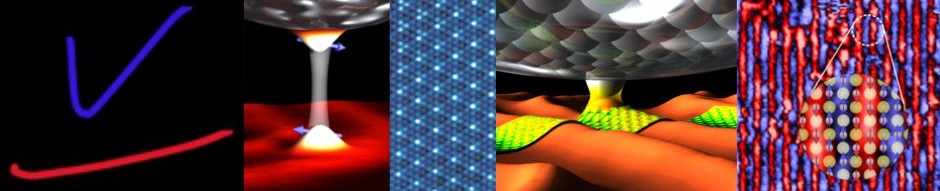
How does a doped Mott insulator avoid becoming metallic? See our new paper in Nature Communications on the surface of the hidden Mott insulator PdCrO2. The surface polarity results in clean doping, yet the system remains insulating. Hidden gem: the local order that prevents metallicity is highly degenerate with local disorder, see below the movie of its dynamics after a voltage pulse. Great collaboration with Phil King’s group and researchers at TDLI, CNR SPIN and the MPI for the Chemical Physics of Solids.

Full reference:
Chi Ming Yim, Gesa-R. Siemann, Srdjan Stavrić, Seunghyun Khim, Izidor Benedičič, Philip A. E. Murgatroyd, Tommaso Antonelli, Matthew D. Watson, Andrew P. Mackenzie, Silvia Picozzi, Phil D.C. King, and Peter Wahl, Avoided metallicity in a hole-doped Mott insulator on a triangular lattice, Nat. Commun. 15, 8098 (2024), arxiv/2311.17139.


 Submit your abstract now for minicolloquium 42 “A quantum leap: unraveling the mysteries of correlated electronic states in quantum materials through atomic-scale imaging and spectroscopy” at the CMD conference in Braga, Portugal, and join us for lively discussions about new insights from atomic-scale imaging of correlated states.


 How good are different surfaces at deactivating SARS-CoV-2 viruses. Copper beats them almost all – except cuprous oxide (Cu2O)! Why is that? Read more in our new paper in Applied and Environmental Microbiology

