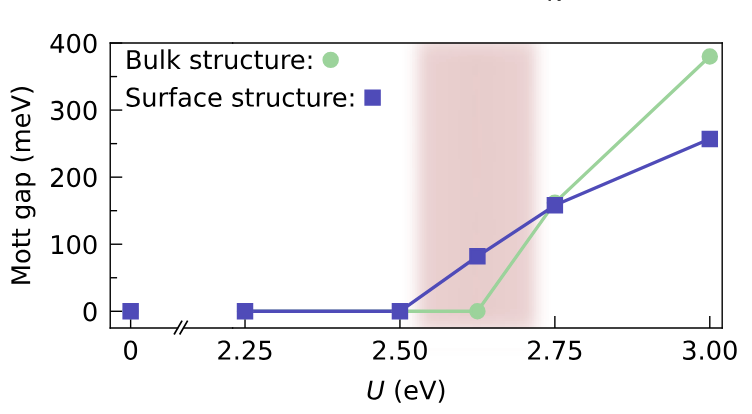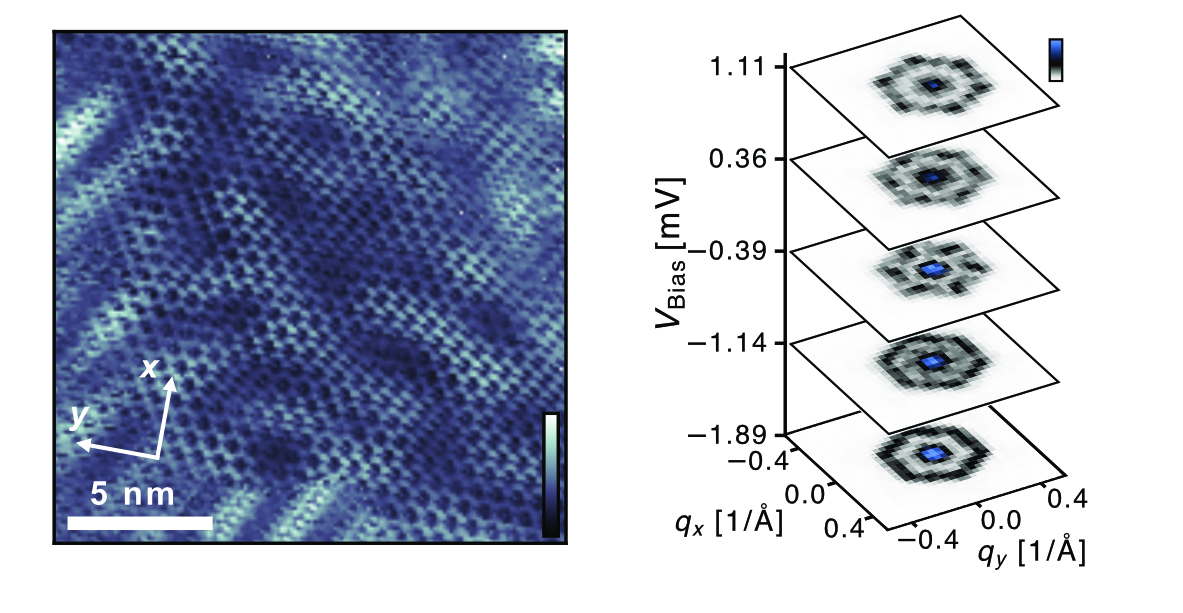
Does the surface of a strongly correlated electron material have the same properties of the bulk? Dan’s new paper (https://lnkd.in/e_nD57-Q) shows from an incredibly detailed structural characterization of the surface of Ca3Ru2O7 how distortions stabilize a surface Mott insulator – seems a common theme in ruthenates that they respond highly sensitively to tiny structural distortions. Great collaborative work within the Centre for Designer Quantum Materials (https://www.cdqm.uk) with the group of Phil King combining structural characterization by low energy electron diffraction with ARPES, STM and DFT calculations, and with samples from MPI Dresden.
Full reference:
Daniel Halliday, Izidor Benedičič, Andela Zivanovic, Masahiro Naritsuka, Brendan Edwards, Tommaso Antonelli, Naoki Kikugawa, Dmitry A. Sokolov, Craig Polley, Andrew P. Mackenzie, Georg Held, Phil D. C. King, and Peter Wahl, Correlated insulator at the surface of the polar metal Ca3Ru2O7, Phys. Rev. Lett. 137, 096503 (2026).